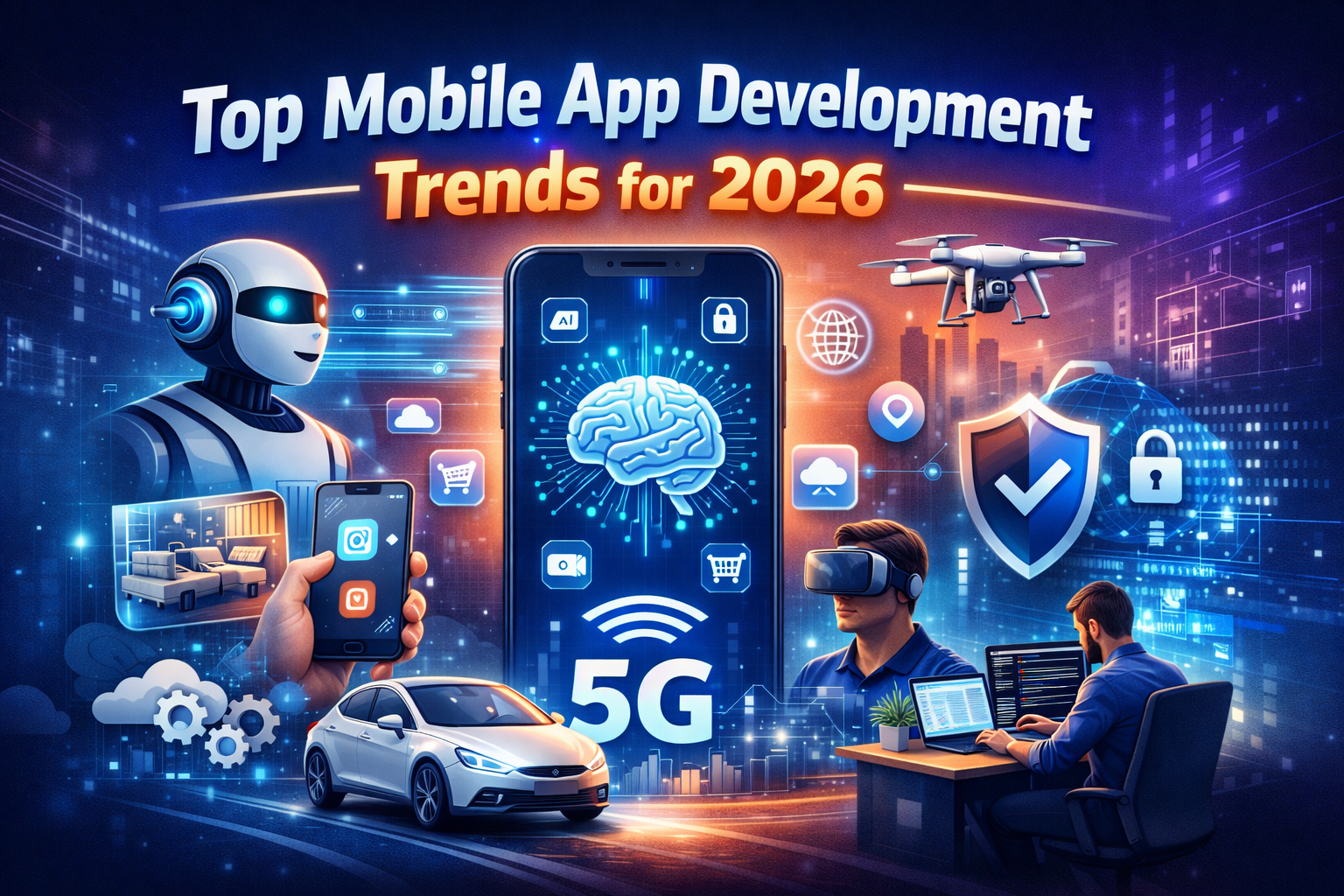
Top Mobile App Development Trends for 2026
The app development of the future has arrived in 2026. Influenced by speedier smartphones, smarter AI apparatuses, privacy-first laws and users. Who cannot stand slow-moving applications or anything less than a hyper-personalized mobile experience. Enterprises today are not so much debating whether they need a mobile app. MILLISECONDS They’re just trying to figure out how to build them smarter. More secure and at the scales we’ve never dreamed of before.” It is executable on a CI/CD pipeline that allows to build. Test, and deploy it on multi-platform whenever the code changes are pushed in.
For startups and enterprises aiming to stay competitive. Now is the best time to align app strategies with these future-forward changes. Many global brands are already choosing to hire mobile app developers in India due to the perfect balance of technical expertise. Cost efficiency, and access to talent experienced in modern frameworks like Flutter, React Native, Kotlin Multiplatform, and AI-integrated app development.
The Rise of AI-First Mobile Apps
AI is no longer a mere addition in mobile apps. By 2026, AI is the foundational layer for how an application behaves, learns from its users and creates value. AI-first applications will leverage machine learning and real-time predictive analytics to tailor user journeys. Delivering automatic support and detecting patterns that drive higher performance and retention.
So what’s special about 2026 is that AI is transitioning from cloud-based to device-centric computation. On-device AI is coming to the fore thanks to its speed of response, privacy friendliness and freedom from the shackles of having a connection;facebook=0.2 but they don’t offer all that much in terms of critical distraction-free steering over voice recognition-type solutions. Apps that manipulate voice, image and text on the device itself will become a baseline assumption rather than a premium add-on.
Generative AI Integration Inside Everyday Apps
Generative AI is becoming more integrated into mobile experiences in pragmatic ways. Apps that produce content like summaries, suggestions, templates, images and text without the user having to leave the app will be mainstream in 2026. This transformation would change the meaning of “productivity apps” and “business apps.”
E-commerce apps are going to use generative AI for more personalized product descriptions and suggestions. Learning apps will create quizzes and adaptive study plans. Fitness apps will develop personalised weekly exercise plans according to progress and performance. Customer service is going this way too, and conversational. AI tools are providing realistic support experiences and making chatbots seem less like robots and more like humans.
App Development Shifts Toward Privacy-First Design
Privacy is no longer a simple check mark on a compliance list. By 2026, this is a critical behaviour of user trust and app branding. Amid increasing global regulation, developers are focusing on data minimization, consent-driven tracking. Transparent privacy policies and more robust standards for encryption. Consumers are more aware than ever of what apps collect, and how that data is put to use; privacy-first design may become a competitive advantage.
Apps that give people easier privacy controls and do least tracking and strongest security around let’s trust auth will win over those where massive silent data snooping is the foundation. And technologies like passkeys, biometric authentication and end-to-end encrypted user sessions are going mainstream. Privacy-first also influences UX design, as apps have to explain security and consent in simple no-techy fashion.
Super Apps and Micro Apps Growing Side by Side
The “super app” concept remains in vogue, particularly in high-growth markets where users favor a single app for payments as well as messaging, shopping, support and service bookings. Meanwhile micro apps are emerging as lightweight focused tools that do one thing very fast and very clearly.
By 2026, enterprises will commonly offer microapp ecosystems that are under one identity on one platform. That’s the best of both worlds. Users can engage with lightweight app modules, while companies own everything beneath unified analytics, authentication and backend infrastructure. This modular approach is very beneficial for businesses that need to innovate quickly. As it allows a single app module to be updated without having an impact on the entire system.
Cross-Platform Development Becoming More Mature
By 2026, cross-platform development is no longer a trade-off. Frameworks such as Flutter or React Native have come a long way, to the point where businesses can develop high-powered, performance intensive apps quicker than they could even by having separate iOS and Android codebases. But what’s even better, Kotlin Multiplatform is gaining momentum – especially if you’re building a shared-business-logic app with native UI experiences.
This is the change by which brands can cut time to market, support a steady stream of features and manage development costs. Reusable code, consistent design and unified performance monitoring are what organisations are focusing on in 2026. Cross-platform tools increasingly also offer better integration with device hardware at the level of code executed on the mobile device, which can be good enough for apps to continue making use of functions such as cameras, sensors, biometrics and AR without becoming unnecessarily hard to manage.
5G and Edge Computing Boosting Real-Time App Experiences
More and more, with the 5G rollout advancing and edge computing improving as well, mobile apps can offer live experiences nearly without lag. In 2026, that will affect industries such as telemedicine, live commerce, gaming logistics and remote collaboration apps.
Live video streaming will become more interactive and shoppable. Real-time delivery tracking and navigation will be more accurate than ever before. (Gaming online multiplayer will also be smoother and more seamless. Edge computing also lessens dependence on central cloud servers by performing data processing closer to the user, enhancing speed and reliability.
Augmented Reality Features Moving into Mainstream Apps
Augmented reality is moving from novelty to necessity. By 2026, AR will be embedded into shopping, education, interior design and decor, tourism and training tools. Consumers are becoming more and more comfortable with using their smartphone camera for AR experiences, particularly when it allows them to make choices more quickly.
Apps designed for e-commerce will let people try products virtually, whether furniture, eyewear or makeup. Educational apps will feature interactive 3D views to enhance learning and engagement. Enterprise apps’ onboarding process will be transformed by AR where employees would quickly learn processes with camera-assisted guidance. This is also confirmed by fact that even moderate hardware development allowed AR to be smooth and realistic.
Mobile App Cybersecurity Becoming a Priority Trend
Cyber risks for mobile apps are on the rise year over year. Security for apps in 2026 is about a lot more than just sticking SSL on it, or basic encryption. Enterprises are moving toward holistic mobile security architecture that encompasses runtime application self-protection, code obfuscation, secure API gateways and ongoing vulnerability scanning.
Secure log-in flows are changing, and passkey and biometric log-ins among many other are becoming more popular. App developers are also targeting secure persistence approaches and the protection of applications from reverse engineering. There is an expectation for apps to be secure by default, and those organisations that cut corners with security implementations doing so at their peril as it will lead to a loss of users over time.
Industry-Specific Apps With Hyper-Personalized Experiences
One of the most compelling trends will be the surge in niche apps designed for particular industries so I’m told. Businesses, rather than generic apps that are trying to serve everyone, are paying for applications that are tailored to the specific needs of their audience, geography and workflow. These apps are catered towards what the industry actually needs, with AI-personalized user experiences to make each app feel like it’s made for that specific end-user.
For example, home service booking apps are becoming more optimized for local search visibility and customer conversion. Businesses that promote such apps also invest in content strategies including keywords like seo for electricians, especially in markets where local competition is intense. Mobile apps in these segments will include smart scheduling, route optimization, automated billing, and real-time customer notifications.
Low-Code Tools Supporting Rapid Prototyping
Full-scale apps still require expert developers to create them, but in 2026 low-code and no-code tools are increasingly being used for prototyping, internal tools and MVP validation. Companies want to test things without spending months on development.
A number of teams are leveraging low-code platforms to build the initial prototype, get feedback, validate workflows on non-scalable architecture and then graduate into their scalable domains once the product proves itself. This hybrid combination is orders of magnitude more cost-effective, lower risk and faster in innovation. Developers benefit as well because they are able to concentrate on complex logic, performance and user experience rather than reusing components.
Conclusion
The key mobile app development trends of 2026 reveal apps that are smarter, faster and more focused on users than we’ve ever seen. Next-gen apps built on a foundation of AI-first design, generative AI features, privacy-first development, superior cybersecurity tools, AR integration and mature cross-platform frameworks will revolutionize apps. Businesses that are early to adopt these trends will create products that can grow more, reach users for longer and adapt quicker based on evolving market demands.
Disclaimer
The information provided in this article, “Top Mobile App Development Trends for 2026,” is intended for general informational and educational purposes only. While every effort has been made to ensure the accuracy, relevance, and timeliness of the content, mobile app development trends, technologies, tools, and regulations may change over time.
This article does not constitute professional, legal, financial, or technical advice. Readers are encouraged to conduct their own research or consult with qualified professionals before making business, development, or investment decisions based on the information presented here.